201.
| CQD Students Receives 1st and 2nd Place Boeing Engineering Award
Boeing press release - December 2, 2009
Can Bayram, a fifth-year PhD student in electrical engineering and computer science and member of the Center for Quantum Devices, was selected as the Boeing Company’s 2009 Engineering Student of the Year. Pierre Yves-Delaunay, another 5th year PhD student also from the Center for Quantum Devices was the runner-up. ... [read more]
|
202.
| Researchers Demonstrate 100-Watt-Level Mid-infrared Lasers
Northwestern University Press Release - December 1, 2009
Northwestern University researchers from the Center for Quantum Devices have achieved a breakthrough in quantum cascade laser (QCL) output power, delivering 120 watts from a single device at room temperature. In this work, Professor Razeghi’s team demonstrated that the ridge width of a broad-area QCL can be increased up to 400 microns, without suffering from filiamentation. As a result, room temperature peak output power as high as 120 watts was obtained from a single device, which is up from 34 watts only a year ago. ... [read more]
|
203.
| University Labs: Where Women Excel
Society of Women Engineers Fall Magazine, Vol. 55, No. 4, p. 48-53 - September 30, 2009
What propels women to head university labs, especially when tenure and biological calendars collide? Manijeh Razeghi director of the Center for Quantum Devices at Northwestern University, stands in the its midst. She had the unique opportunity to build her center from the ground up. In her words, her goal was "to decrease the gap between research and production, while facing all the technical challenges and stringent requirements in order to ensure a safe and invigorating working environment." ... [read more]
|
204.
| ULTRAVIOLET DETECTORS: Nitrides push performance of UV photodiodes
Laser Focus World, p. 47-51 - September 1, 2009
Nitrides offer considerable advantages over other materials for ultraviolet detection. Recently, they proved useful for creating the world’s first UV single-photon detectors with efficiencies to 20%–detectors that could enable quantum computing and data encryption. ... [read more]
|
205.
| ULTRAVIOLET DETECTORS: Nitrides push performance of UV photodiodes
OptoIQ (A subsidiary of Laser Focus World) - September 1, 2009
Nitrides offer considerable advantages over other materials for ultraviolet detection. Recently, they proved useful for creating the world’s first UV single-photon detectors with efficiencies to 20%–detectors that could enable quantum computing and data encryption. ... [read more]
|
206.
| Superlattices see in the dark
SPIE Newsroom - July 28, 2009
Six years ago, the Center for Quantum Devices (CQD) at Northwestern University fabricated the first IR camera based on Type-II material. After that, the CQD focused on improving the optical and electrical performance of the imager. We developed a new variant of a type-II superlattice, called M-structure, because of the M-shape of the band alignment, which allows for more-flexible control of the energy gap, energy levels, and effective mass. Many processing imporovements were also developed. The design, fabrication, and processes improvments have combined to make type-II superlattices a viable alternative to HgCdTe for IR imaging. ... [read more]
|
207.
| 2009 IEEE Photonics Society Graduate Student Fellowship Awarded to Pierre-Yves Delaunay and Can Bayram
IEEE Photonics Society - July 21, 2009
The IEEE Photonics Society Membership Committee has selected Pierre-Yves Delaunay and Can Bayram as two of the winners of the 2009 IEEE Photonics Society Graduate Student Fellowships. The Fellowship consists of a one-time award of a $5000.00 honorarium. In addition to the Fellowship Award, complimentary registration to the meeting and a travel grant of up to $2500.00 is available to attend the Photonics Society 2009 Annual Meeting. ... [read more]
|
208.
| SPIE Awards $4000 Scholarship to Binh-Minh Nguyen
SPIE Press Release - May 8, 2009
SPIE has awarded a $4000 SPIE Scholarship in Optical Science and Engineering to Binh-Minh Nguyen, Northwestern University. Binh-Minh is a PhD candidate studying applied science at the Center for Quantum Devices (CQD) at Northwestern Univ. under the direction of Walter P. Murphy Professor and Director, Manijeh Razeghi. ... [read more]
|
209.
| SPIE Awards $6000 Scholarship to Can Bayram
SPIE Press Release - May 6, 2009
SPIE has awarded a $6000 SPIE Laser Technology, Engineering and Applications Scholarship to Can Bayram, Northwestern University. Can Bayram is a PhD candidate studying applied science at the Center for Quantum Devices (CQD) at Northwestern University under the direction of Walter P. Murphy Professor and Director, Manijeh Razeghi. ... [read more]
|
210.
| French Connections: Manijeh Razeghi Thinks Globaly
McCormick - May 1, 2009
Part of Professor Razeghi's heart and soul will always be in France. Though she came to the United States more than 17 years ago, she got her start in Paris, and all of her family is still in France. She keeps up her French connections by collaborating with prestigious French universities -- and recruiting their best students. ... [read more]
|
211.
| Northwestern Students Receive $10,000 Prizes from the Dow Sustainability Innovation Challenge
McCormick - March 23, 2009
The Northwestern Institute for Sustainable Practices will award CQD Graduate Student Can Bayram and two other student groups a $10,000 prize from the Dow Sustainability Innovation Challenge in recognition of research contributing to global sustainability. ... [read more]
|
212.
| Modern Atomic Engineering: Inspirations from Nature
EECS Distinguished Speaker Series, Northwestern Univeristy - December 3, 2008
On December 3rd, 2008 Professor Razeghi gave a Distinguished lecture presentation titled "Modern Atomic Engineering: Inspirations from Nature" A video of this talk can be viewed at http://www.eecs.northwestern.edu/video/razeghi.html ... [read more]
|
213.
| Light-Emitting Diodes: ZnO does away with green-LED problem
Laser Focus World - November 2, 2008
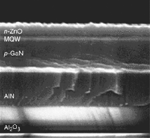
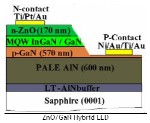
While blue and red LEDs can be made to shine brilliantly and have a long life, high-brightness green LEDs tend to die early. Now, scientists at Northwestern University (Evanston, IL) and Nanovation SARL (Orsay, France) have developed a type of green LED that has the potential to burn brightly while enduring year after year. Still in the early prototype stage, the hybrid-LED has a novel design that keeps the indium within its diode structure from diffusing over time and reducing the diode’s light output. ... [read more]
|
214.
| Women in Optics Calender 2009
SPIE - November 1, 2008
What I find exciting
I appreciate the challenge of starting and developing a company, based on the fabrication of an emerging semiconductor (ZnO) that nobody would have bet on in 1999, and which has turned out to be one of the hottest topic in materials science ten years latter. ... [read more]
|
215.
| Laser gunship hits $30 million bulls-eye
CNET News - October 17, 2008
Northwestern University engineering professor Manijeh Razeghi said there is a range of potential military uses for lasers. "Lasers can create fires. They can kill. Each laser wavelength has some application. Some of them you know about; some of them are classified, and we cannot speak about them." ... [read more]
|
216.
| Airborne lasers to replace bombs? Boeing develops new ground-attack weapon
Medill Reports, Chicago - October 16, 2008
“Lasers can create fires, they can kill,†said Manijeh Razeghi, an engineering professor at Northwestern University, who has developed lasers for the military. “Each [laser] wavelength has some application. Some of them you know about, some of them are classified and we cannot speak about them.†... [read more]
|
217.
| Powerful QCLs eye remote sensing
Compound Semiconductor - October 15, 2008
Our eyes tell us a great deal about our environment. However, they can’t spot the numerous invisible threats to our health and safety. What’s needed is a low-cost remote chemical sensor. Optical detection schemes are ideal for this task
because they can quickly cover vast areas with high-power lasers that are directed far from the detection system. The most promising source for remote mid-infrared sensing is the quantum cascade laser (QCL), currently being developed by researchers at the Center for Quantum Devices. ... [read more]
|
218.
| Atomic Engineering of Quantum Systems in Group III-V Semiconductors for IR Detection and Imaging
Advanced Systems and Technology (AST) Directorate's Technology Seminar seris - October 7, 2008
Tuesday, 7 October 2008 Professor Razeghi gave a prestigious seminar in the J.D. Hill Conference Center Auditorium covering her Quantum Dot Infrared Photodetector and Focal Plane Array research. ... [read more]
|
219.
| ZnO/GaN hybrid shows green LED promise
Compound Semiconductor .Net - September 3, 2008
Hybrid LED structures featuring GaN and ZnO layers could produce higher performance green
emitters than existing devices. Northwestern University and French startup Nanovation showed the concept's feasibility by making an LED with peak continuous-wave electroluminescent emission in the order of 2 mlm at 510 nm. These results were published in the in the August 25th issue of Applied Physics Letters. ... [read more]
|
220.
| The Quantum Cascade Laser: A versatile and Powerful Tool
Optics and Photonics News - July 30, 2008
Many important applications in the infrared are awaiting the right laser source. Advances in Quantum Cascade Lasers will enable powerful new technologies to become realities. ... [read more]
|
221.
| Nanostructured Sensors
SPIE Professional - July 1, 2008
Infrared photon imaging between 3 and 14 μm has important applications in security, defense, astronomy, and a number of other areas. Researchers at the CQD have overcome several challenges in integrating Type II superlattice materials into IR imaging systems. Their innovative work using Nanotechnology to create these structures has resulted in fabrication of the first high-quality IR
camera with a 10 μm cutoff wavelength. ... [read more]
|
222.
| Type-II FPA on the Cover
IEEE Journal of Quantum Electronics, Vol. 44, No. 5&6 - June 1, 2008
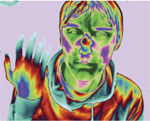
The one of the CQD's most recent publications in the IEEE Journal of Quantum Electronics was chosen for the cover of the May-June issue. The cover photo consist of an image of Graduate Student Pierre-Yeves Delaunnay taken with an LWIR Type-2 FPA. ... [read more]
|
223.
| New Superlattice Structure Enables High Performance Infrared Imaging
McCormick Press Release - May 27, 2008
Scientists at the Center for Quantum Devices (CQD) in the McCormick School of Engineering at Northwestern University have demonstrated for the first time a high-performance infrared imager, based on a Type II superlattice, which looks at wavelengths 20 times longer than visible light. ... [read more]
|
224.
| New Mid-Infrared Lasers Show Doubled Efficiency
McCormick Press Release - May 19, 2008
Researchers at the Center for Quantum Devices at the McCormick School of Engineering at Northwestern University have recently doubled the efficiency of infrared lasers under the U.S. Defense Advanced Research Projects Agency’s Efficient Mid-wave Infrared Lasers (EMIL) program. ... [read more]
|
225.
| Type-II semiconductor superlattice photodetectors new alternative to HgCdTe
Laser Focus World - May 15, 2008
In a invited talk at SPIE's Defense + Security Symposium March 17th, Professor Manijeh Razeghi announced that Type-II InAs/GaSb photodetectors may now be an important alternative to existing detectors in the LWIR and VLWIR ranges. ... [read more]
|


 Channel



.jpg)





.jpg)

 Address: Center for Quantum Devices; 2220 Campus Drive RM 4051; Evanston, IL 60208-0893
 Phone: (847) 491-7251
 Email: razeghi@northwestern.edu